
More than 350,000 out-of-hospital cardiac arrests occur in the United States each year: and only about 40% of victims receive bystander CPR before emergency medical services arrive. This September, National Preparedness Month is a timely reminder that emergency readiness is not only about flashlights, evacuation plans, and emergency kits. It is also about knowing what to do when someone suddenly collapses at home, at school, at work, or in the community.
For parents, teachers, school staff, office teams, and neighbors throughout Massachusetts, CPR, First Aid, and AED certification should be considered core preparedness skills: not optional extras.
The good news? You do not need to be a medical professional to make a meaningful difference. With quality training and hands-on practice, ordinary people can become confident first responders while professional help is on the way.
Why does CPR belong in every Massachusetts emergency plan?
According to the American Heart Association, most out-of-hospital cardiac arrests happen in homes and residences. That means the person who needs help may be a spouse, parent, child, friend, coworker, or neighbor: not a stranger in a public place.
Cardiac arrest is different from a heart attack. During cardiac arrest, the heart suddenly stops pumping effectively, preventing blood from reaching the brain and vital organs. Brain damage can begin within minutes. Immediate CPR helps maintain circulation until an AED or emergency medical team can restore a normal heart rhythm.
The American College of Emergency Physicians reports that 55% of adults feel prepared to provide hands-only CPR, but only 29% feel prepared to use an AED. Training can close that confidence gap.
"A medical emergency can happen at any time and quick action by a bystander can be the difference between life or death," said Christopher S. Kang, MD, FACEP, former president of ACEP. "Everyone can learn some easy steps to take so that they can help in an emergency."
Preparedness begins with knowing that you can act.
What should adults do during a cardiac emergency?
Formal certification provides the most complete preparation, including skills practice, feedback, and scenario-based learning. However, knowing the basic sequence can help you respond more quickly while waiting for help.
If an adult or teen suddenly collapses and is unresponsive:
- Check the scene. Make sure it is safe for you to approach.
- Check responsiveness and breathing. Tap the person and shout. Look for normal breathing (occasional gasping is not normal breathing).
- Call 911. If others are present, direct someone to call 911 and another person to retrieve the nearest AED. If you are alone, call 911 and follow the dispatcher's instructions.
- Begin CPR. Push hard and fast in the center of the chest at a rate of 100-120 compressions per minute.
- Use the AED as soon as it arrives. Turn it on, attach the pads as shown, and follow the device's voice prompts.
- Continue until help takes over, the person shows signs of life, or you are physically unable to continue.
A helpful memory aid is the rhythm of the song "Stayin' Alive," which is close to the recommended compression rate. (Do not stop compressions simply to check for a pulse unless you are trained to do so and the situation calls for it.)
Infants and children require different considerations, and rescue breaths may be part of a trained responder's protocol. That is one reason a comprehensive CPR/First Aid/AED course is so valuable: you practice the right response for adults, children, and infants: not just memorize a checklist.
You do not have to be perfect to start helping. You have to recognize the emergency, call for help, and begin.
Are Massachusetts schools ready for the first weeks of fall?
September brings a major transition for Massachusetts schools. Students return to classrooms, teachers and staff adjust to new routines, athletic programs begin, and school buildings fill with activity again.
That makes the first weeks of the school year an ideal time to review emergency readiness.
Teachers and school staff may be the first adults available when a student, colleague, coach, or visitor experiences a medical emergency. A school's preparedness plan should include:
- A clear process for calling 911 and directing responders to the correct entrance
- Staff members who know where AEDs and first aid supplies are located
- Current emergency contact and medical information
- CPR and First Aid training for teachers, administrators, nurses, coaches, and support staff
- Practice coordinating care while another person meets arriving EMS professionals
This applies whether your school is in Woburn, Burlington, Winchester, Lexington, Reading, Medford, Malden, Melrose, Everett, Cambridge, Chelsea, or another nearby Massachusetts community.
Wicked Safety Training offers hands-on instruction for schools and can bring training directly on-site. That allows teams to learn together in the environment where an emergency could actually occur: while identifying practical issues such as AED locations, access points, and communication procedures.
How can workplace teams build real confidence: not just compliance?
An online certificate may satisfy a requirement, but hands-on training helps people develop the muscle memory and judgment needed in a stressful moment.
For office teams, healthcare facilities, childcare programs, nonprofits, fitness centers, restaurants, and other workplaces, CPR readiness can be built into the fall safety calendar. Consider scheduling training alongside:
- Annual workplace safety reviews
- Back-to-school staff meetings
- New employee onboarding
- Fire drills and emergency evacuation exercises
- Occupational health or compliance training
- Community wellness events
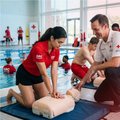
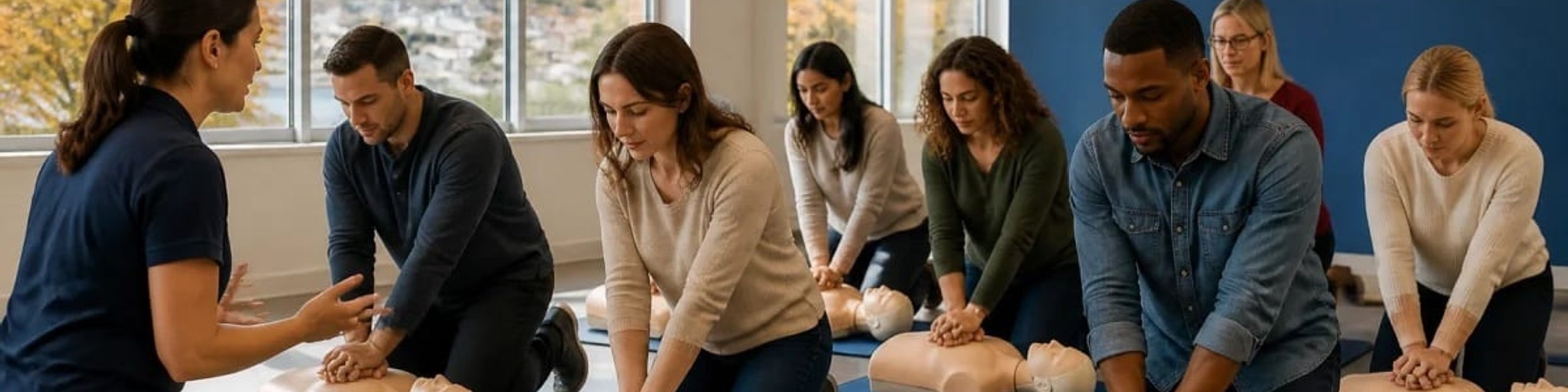
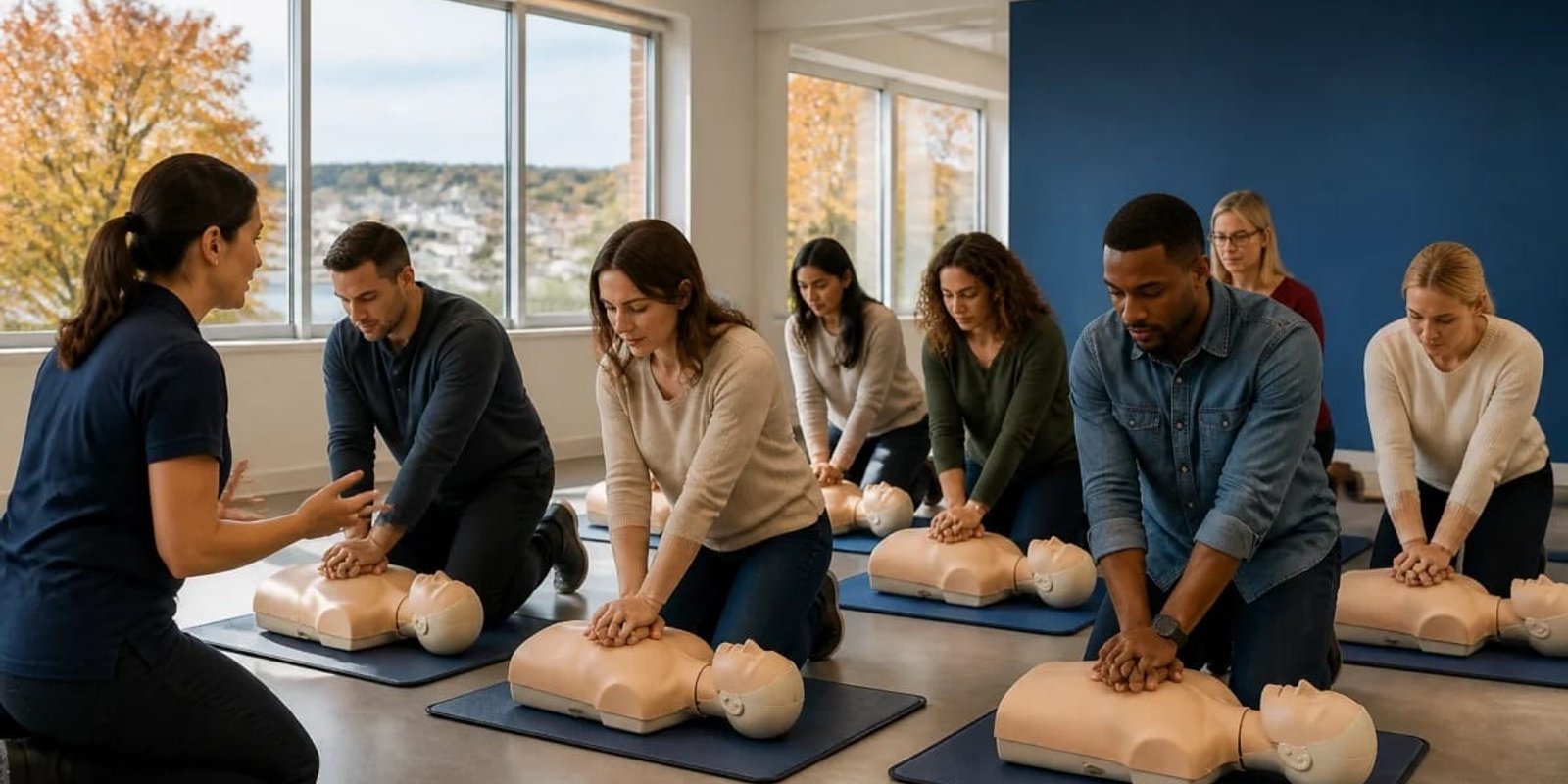
During a course, participants can practice chest compressions, rescue breathing, AED operation, choking response, bleeding control, and other First Aid skills. They can also ask questions specific to their workplace and receive immediate feedback from a certified instructor.
At Wicked Safety Training, students train in a professional, supportive environment at our Woburn, Massachusetts, training center. Businesses, schools, and community organizations can also request on-site instruction that fits their schedule and facility.
Our track record reflects that personal, practical approach: Wicked Safety Training has been recognized as New England's top training provider for three years running, has taught more than 2,500 classes since 2019, and has certified over 12,000 students.
Training is not about creating fear. It is about replacing hesitation with a plan.
What is the difference between CPR, First Aid, and AED certification?
Each skill addresses a different part of emergency response:
- CPR certification teaches recognition of cardiac arrest, chest compressions, rescue breaths, and coordinated response.
- AED training teaches participants how to safely operate an automated external defibrillator and follow its prompts.
- First Aid certification covers common injuries and illnesses, including severe bleeding, burns, fractures, allergic reactions, and other urgent situations.
- Pediatric training focuses on the needs of infants and children, making it especially relevant for parents, teachers, childcare providers, and youth program staff.
Wicked Safety Training offers American Heart Association, American Red Cross, and American Safety and Health Institute options, including full in-person classes and blended formats. Healthcare professionals who need advanced preparation can also explore Basic Life Support training.
The right course depends on your role, workplace requirements, and the people you serve. If you are uncertain, contact Wicked Safety Training and our team can help you identify an appropriate option.
How can you make preparedness a September habit?
National Preparedness Month is an opportunity to take one practical step at a time. FEMA's Ready campaign encourages Americans to make a plan, build a kit, stay informed, and support community resilience. CPR and First Aid training fit naturally into that framework.
Use this simple September checklist:
- Choose your training. Decide whether you need general CPR/First Aid/AED, pediatric training, or healthcare-focused BLS.
- Register your household or team. Preparedness is stronger when several people know how to respond.
- Locate nearby AEDs. Check your home, school, workplace, gym, community center, and regular travel routes.
- Save emergency information. Keep addresses, medical details, medications, and emergency contacts accessible.
- Practice your plan. Discuss who will call 911, who will retrieve the AED, and who will meet EMS.
- Refresh your skills regularly. Certification requirements vary, and periodic practice helps maintain confidence.
A medical emergency may happen on a busy day in Boston, during a school activity in Lexington, at an office in Cambridge, or at home in Woburn. You cannot predict when help will be needed. You can prepare to provide it.
Ready to become the person who acts?
This September, make CPR readiness part of your family, school, workplace, or community preparedness plan.
Browse CPR, First Aid, and AED classes at the Wicked Safety Training center in Woburn, or register for an upcoming class. For schools and workplaces that prefer group instruction, request on-site training.
Whether you live in Burlington, Winchester, Medford, Malden, Melrose, Everett, Cambridge, Chelsea, Boston, or another community within reach of Woburn, the next step is simple: learn the skills, practice the response, and be ready to help.
The power to save a life may be literally in your hands.